





Morels
Morchella esculenta e specie affiniGuide to morels in Europe: where Morchella esculenta grows, when to pick it and how to identify it. Woods, clearings and orchards in the spring season.
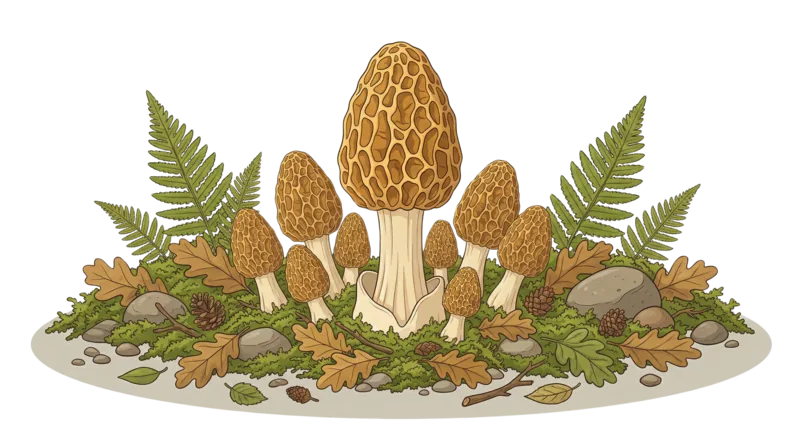
Morels — the genus Morchella — are among Europe's most sought-after and prized spring mushrooms. Morchella esculenta and related species (M. elata, M. conica) fruit between March and May, when most autumn mushrooms are still a distant memory. They grow in very different habitats: mixed and riparian woods, post-fire clearings, abandoned orchards, path edges. Their sponge-like honeycomb cap makes them unmistakable. Excellent both fresh and dried, they are among the most gastronomically prized of all mushrooms.
Informational content. No online text or image replaces identification by an expert mycologist: if in doubt, do not eat the mushroom.
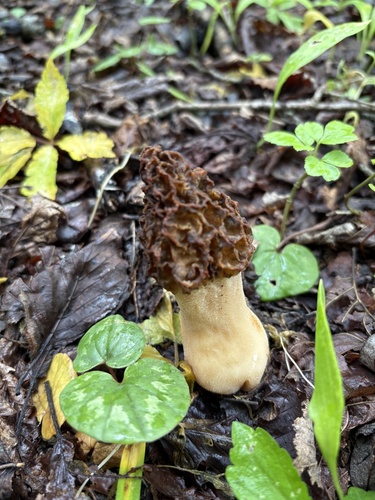
iNaturalist observation · Photo: Екатерина Кравцова · CC BY
Reading the species through its habitat
Aby zrozumieć ten gatunek, trzeba połączyć siedlisko, sezon i reakcję na lokalne warunki. Sama nazwa mówi niewiele: las i gleba wyjaśniają, gdzie może się pojawić.
Morels — the genus Morchella — are among Europe's most sought-after and prized spring mushrooms. Morchella esculenta and related species (M. elata, M. conica) fruit between March and May, when most autumn mushrooms are still a distant memory. They grow in very different habitats: mixed and riparian woods, post-fire clearings, abandoned orchards, path edges. Their sponge-like honeycomb cap makes them unmistakable. Excellent both fresh and dried, they are among the most gastronomically prized of all mushrooms.
Moisture and weather conditions
Recent rainfall is only one part of the picture. What matters is how water is distributed over time, how long the litter can retain it and whether the soil remains aerated. Shade, wind, aspect and canopy cover can quickly change how the same habitat responds.
Temperature should be read alongside the species’ season. Rather than relying on a fixed threshold, look at the sequence of mild days, cooler nights, available soil water and the absence of prolonged stress.
Soil, elevation and aspect
Drainage, texture, litter and water-holding capacity describe the ground more usefully than elevation alone. Compare the model with vegetation type, slope and aspect.
Elevation shifts the calendar by changing temperature, moisture and the length of the season, but rarely creates a hard boundary. Two slopes at the same height can still have very different conditions.
A calendar written by elevation and climate
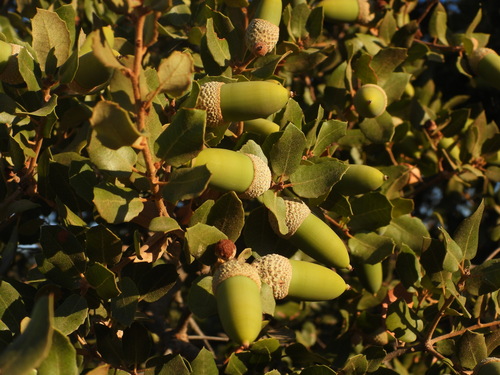
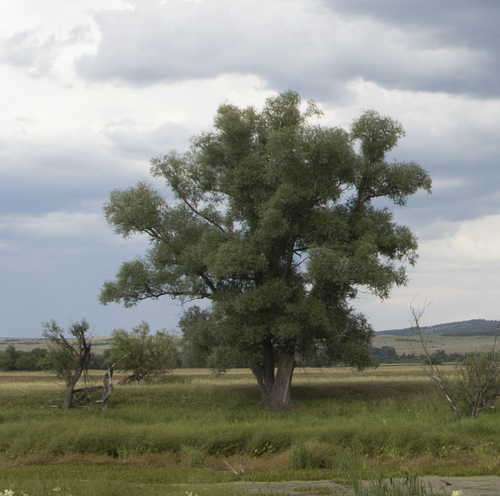
Mixed broadleaf woods (elm, ash, oak), riparian zones, abandoned orchards, clearings after fire or logging, path edges with disturbed soil. They prefer soils rich in limestone and spring moisture. From 100 to 1200 metres.
The fruiting period of morels shifts with elevation and weather. Each year brings a different sequence of growth, pauses and renewed activity depending on soil water and local temperatures.
The morels profile
Mitre-shaped cap with irregular honeycomb-sponge surface Ochre-brownish or yellow-beige colour, darker in related species Completely hollow cross-section — both cap and stem Cylindrical whitish stem, irregularly ribbed Solitary or small groups, never in compact clusters
Where morels may fruit
Explore the combination of habitat, elevation, aspect, recent rainfall and soil conditions that the model associates with a more favourable context for morels.